
Article: How to choose a quality dog bed: comfort, support, easy care, and sustainability
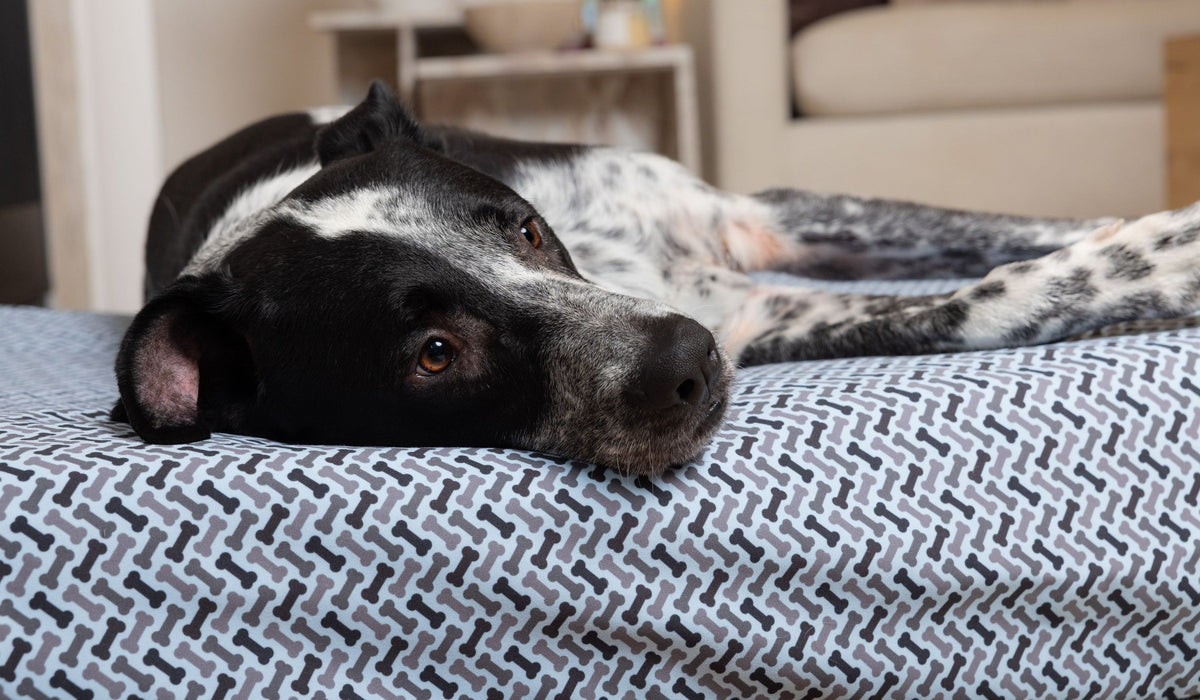
How to choose a quality dog bed: comfort, support, easy care, and sustainability
Dogs spend a lot of time sleeping and resting. Yet we often choose their dog bed based mainly on appearance, price, or how soft they feel on the surface.
A better approach is to consider the whole sleeping environment. A quality dog bed should feel comfortable enough that your dog wants to use it. It should provide cushioning and support under your dog's weight. The bed should give your dog enough room to change sleeping positions. It should also use durable materials, be easy to keep clean, and be designed to last.
These qualities become even more important for older dogs and dogs with arthritis or mobility problems.
A note of warning: don’t select a bed just because it is called “orthopedic”. This is a highly overused description without any specific definition. You will need to dig deeper.
What makes a good dog bed?
There is no single best dog bed for every pet. A small dog that curls into a ball has different needs from a 90-pound dog that sleeps stretched across the floor. An active young dog has different needs from an older dog with arthritis.
Still, every pet parent can consider the same basic qualities:
- Comfort: Does your dog actually like sleeping on it?
- Support: Does the bed cushion the body without bottoming out?
- Size: Can your dog sleep and change positions naturally?
- Construction: What is inside the mattress?
- Materials: Are the materials appropriate for your dog's needs and your priorities?
- Durability: Will the bed retain its shape, support, and appearance?
- Easy care: Can you easily wash the part your dog sleeps on while protecting the mattress?
- Sustainability: How long should the product remain useful, and can worn components be replaced?
Let's look at each of them.

Comfort: Will your dog actually sleep on the bed?
Comfort involves more than softness. Dogs may have preferences for the feel of the sleeping surface, temperature, location, size, and familiarity of a bed. A dog bed can have excellent materials and construction. But none of that matters if your dog won't use it.
When introducing a new dog bed, make it familiar rather than expecting your dog to immediately understand that this new object is the new sleeping spot.
- If your dog already has a favorite sleeping location, put the new bed there.
- Put a favorite blanket, pillow, or toy on it. The familiar scent can help make a brand-new bed seem more like your dog's own space.
- Give your dog time to investigate and choose the bed voluntarily.
Comfort can also change with age. A surface that suits a young dog may not work as well when that dog grows larger, or develops stiffness or reduced mobility. A super soft topper can help cushion older joints.
And remember that comfort and support are not the same thing. A bed can feel wonderfully soft and still provide very little support once your dog's weight is on it.
Support: What happens when your dog lies down?
Most pet beds are only a few inches thick.
That can be enough if the mattress materials maintain adequate depth under your dog's weight. But a bed that starts out three or four inches thick may provide surprisingly little cushioning if most of that thickness disappears when weight is applied.
The real question is:
How much supportive material remains between your dog's body and the floor after your dog lies down?
This is particularly important for larger dogs and the heavier areas of the body, such as the shoulders and hips.
We wanted to see this for ourselves.
We purchased several popular pet beds from Amazon and conducted simple comparison tests. We placed the same load (25 pounds) on different types of bedding and measured how far each bed compressed.
The differences were striking.
In the products we tested, a loose-fill bed and conventional single-layer foam beds compressed substantially under modest weight. In some cases, very little material remained between the weight and the floor.
The three-layer Blue Toby Eco Support mattress retained considerably more depth beneath the same load.

We compared popular pet beds purchased from Amazon with the Blue Toby Eco Support mattress using the same informal compression test. These demonstrations are not standardized laboratory tests, and the results apply only to the products we tested.
You can check out the details of these informal pet bed compression demonstrations on TikTok.
While our simple test may not apply to all beds, it illustrates an important point:
A dog bed can feel soft when you press it with your hand, yet provides little cushioning between your dog's body and the floor once weight is applied.
We need to look beyond hand-softness to understand comfort and support in dog beds.
Foam density and firmness are not the same thing
If you start comparing foam mattresses, you may encounter two terms that sound as though they mean the same thing: density and firmness.
They don't.
- Density describes how much material is present in a given volume of foam.
- Firmness describes the force required to indent the foam by a specified amount.
Dense foam can therefore be relatively soft. A lower-density foam can be relatively firm.
Why does this matter?
Firmness helps describe how a foam feels and responds to a load. Density provides important information about foam durability and retention of physical properties.
There is another useful characteristic called support factor, or compression modulus. It describes how a foam's resistance increases as it is compressed more deeply.
The Polyurethane Foam Association provides a useful technical explanation of these differences (Foam Performance).
For a pet bed, the practical lesson is simple:
Softness and support are not opposites. A well-designed mattress can feel comfortable at the surface while providing stronger support deeper in the mattress.
Size: give your dog room to sleep like a dog
Do not choose a dog bed based only on your dog's weight. Watch how your dog actually sleeps.
Does your dog curl tightly into a ball? Sleep on one side? Stretch the front and back legs in opposite directions? Change positions throughout the night?
Dogs that stretch out need considerably more surface area than dogs that curl up.
Measure the usable sleeping surface of the bed, not simply the outside dimensions. Bolsters and raised sides reduce the space available for your dog's body.
Blue Toby beds are intentionally made wider than many conventional pet beds. The extra width gives dogs room to change positions and stretch out instead of forcing them into one sleeping posture.
If two pets like to sleep together, allow room for both.
I discussed sizing, sleeping position, bed height, and other practical considerations in more detail when I contributed to a U.S. News & World Report article about orthopedic dog beds.
Construction: look inside the bed
This may be one of the simplest pieces of advice in this article:
Open the bed and look inside.
If there is a zipper, unzip it.
Don't assume a thick-looking bed contains a thick, supportive mattress. Find out what actually creates the thickness.
Is it loose stuffing? A single piece of foam? Several foam layers? Latex? Another support material?
Look at how thick the mattress really is and what the individual layers do.
Avoid loose fill for a supportive mattress
Loose fiberfill can make a bed look thick and plush when it is new. But it has significant disadvantages when used as the primary support material in a dog bed. Loose fill can shift away from the parts of the body that need support. It can clump, flatten, and compress with use.
The result can be an uneven sleeping surface with much less cushioning than the bed's original appearance suggests.
Our compression demonstration showed this clearly in the loose-fill bed we tested. The fill moved and compressed substantially beneath the load.
Fiberfill can work well in products such as pillows and bolsters. But for the primary mattress of a supportive dog bed, we prefer materials that maintain a more consistent structure.
Why can multiple mattress layers be useful?
Different layers can perform different jobs within a mattress.
For example, the Blue Toby Eco Support mattress has three layers:
- A soft convoluted gel-foam top layer provides surface cushioning and air flow.
- A soft gel-foam middle layer adds cushioning and depth.
- An open polymer base provides deeper structural support.
Blue Toby's Classic Comfort mattress takes a different approach. It combines a soft convoluted foam surface with a firmer, high-density support layer.
The NaturaLuxe mattress uses natural latex, with a softer convoluted upper layer and a more supportive latex layer beneath it.
The point is not that every quality dog bed needs three layers. Rather, ask what each part of the mattress is designed to do.

Beds for large or special-needs dogs
For large dogs or those with arthritis, hip dysplasia, or other physical conditions, ensure that your bed has several inches of a soft cushioning layer on top and a thick, firm support layer underneath. Also consider using a waterproof cover for accidents that become more common when dogs age.
Materials: what is the mattress made from?
Once you have opened the bed, identify the materials.
Terms such as "premium orthopedic filling" tell you very little. Specific materials and specifications tell you much more.
Polyurethane foam
The most common dog bed mattress material is polyurethane foam. It comes in many forms. Its density, firmness, resilience, cell structure, and formulation affect how it behaves.
Memory foam is a viscoelastic polyurethane foam. It conforms slowly under pressure and has slow shape recovery (it doesn’t rebound quickly when the dog moves). That body-conforming feel can provide excellent cushioning. However, its slow recovery may be less suitable for a dog that changes positions frequently during sleep. Traditional memory foam can also retain body heat because the dog often sinks deep into it, which some dogs may find uncomfortable.
Conventional flexible polyurethane foam can be manufactured in a wide range of densities and firmness levels. A higher-density support foam can provide structural support underneath a softer comfort layer.
Gel foam is designed to help dissipate heat. The material we chose for Blue Toby beds is a human bedding product made of open-cell gel foam with rapid shape recovery and heat dispersion. This provides soft cushioning without the slow response associated with traditional memory foam.
Whatever type of polyurethane foam you consider, look for actual specifications and third-party certification rather than relying only on the word "orthopedic."
Natural latex
Natural latex is resilient, responsive, and exceptionally durable. It returns quickly after compression rather than slowly retaining the shape of the load. This allows latex to provide a useful combination of cushioning and support.
But be careful with the word "latex." Products marketed as latex can use different formulations. If organic natural latex is important to you, look for Global Organic Latex Standard (GOLS) certification. GOLS establishes requirements for latex products made from certified organic raw material and also addresses processing and manufacturing requirements.
Blue Toby's NaturaLuxe mattresses use 100% GOLS-certified organic Dunlop latex.
Alternative support materials
Not every supportive mattress needs to be made entirely from foam.
The base of Blue Toby's Eco Support mattress is a high-tech open polymer support structure. It contains thousands of interconnected points of support with substantial open space between them, allowing air to move through the layer. The material is also recyclable.
Fabrics should be durable and comfortable
A dog bed fabric has a difficult job. It needs to withstand claws, digging, washing, body oils, hair, and years of daily use.
But durability alone isn't enough. Softness and comfort matter.
Some pet beds use very heavy canvas fabric because it withstands abrasion. Canvas can work well for some dogs, but very stiff or crinkly fabric may not create the soft, quiet sleeping surface that many dogs prefer.
Look for a balance between durability and comfort.
For the protective mattress cover, consider the same type of high-quality upholstery fabric you might expect on a well-made sofa. Upholstery fabrics are designed to withstand repeated contact and abrasion while remaining comfortable.
All Blue Toby mattresses use high-quality upholstery fabrics for this reason.
Durability: Will the bed still perform years from now?
A dog bed is used every day.
Dogs scratch, dig, circle, jump onto the bed, and push against the fabric. Covers go through repeated washing. Mattress materials experience thousands of cycles of compression and recovery.
Quality construction should account for this.
We conducted an admittedly extreme informal durability demonstration with Blue Toby and another popular pet-bed cover.
We attached the cover materials to a tractor with a chain and pulled them.
No, your dog is unlikely to own a tractor. But the demonstration offers a memorable way to see how the materials we tested responded to substantial stress. And it was fun!

Watch our dog-bed cover durability comparison on TikTok.
As with our compression testing, this was an informal demonstration rather than a standardized textile-strength test.
When evaluating durability, look for:
- substantial but comfortable fabric
- strong seams
- quality zippers and construction
- mattress materials that resist flattening
- replaceable covers
- a meaningful warranty
Fabric durability testing
The upholstery fabric industry has true measurements for durability and abrasion. The US uses a measure called the Wyzenbeek Test (or the “double rub” test). A fabric that is rated at 30,000 double rubs has survived 30,000 back-and-forth cycles of the test. The Matindale Test is more common in Europe, but has a different metric. This site has a good explanation of abrasion tests and what they mean.
Our Blue Toby beds have soft but heavyweight upholstery covers. NaturaLuxe organic cotton upholstery is rated at 40,000 double rubs, and the Crypton upholstery used in our other collection is rated at 100,000 double rubs!
Durability also matters for sustainability. A bed that remains useful for many years does not need to be replaced as frequently. This keeps pet beds out of the landfill!
A word of warning while we are on the topic of durability: be wary of claims of an indestructible dog bed. There really is no such thing. Learn more about The myth of the "indestructible" dog bed.

Why support and comfort matter for dogs with arthritis: what the science says
A good bed does not treat arthritis. However, a comfortable and supportive resting area can be part of creating a better environment for a dog with arthritis, joint pain, hip dysplasia, or mobility problems.
International consensus guidelines for canine osteoarthritis specifically identify comfort, including beds and rest areas, as an important environmental consideration (Cachon et al., 2023).
Researchers have also found that osteoarthritis pain can affect dogs at night. A study of client-owned dogs with naturally occurring osteoarthritis used activity monitoring and clinical measurements to evaluate nighttime restlessness associated with osteoarthritis pain (Knazovicky et al., 2015).
This is an important reminder that joint discomfort doesn't matter only when a dog is walking. Rest matters, too.
What does research tell us about pressure and bedding?
Direct research comparing dog beds is surprisingly limited.
One veterinary study provides useful information. Researchers compared blankets on a floor, a standard mattress, a veterinary memory-foam mattress, and a human memory-foam mattress. They measured contact pressure at different areas of dogs' bodies.
Pressure-relieving mattresses produced lower pressures at vulnerable areas than standard mattresses or blankets on the floor. The study used only three cadaver dogs. It was also designed to investigate pressure-sore prevention rather than ordinary household sleep (Caraty et al., 2019).
We should not overstate those findings. Still, the study demonstrates an important principle:
The surface underneath a dog's body can affect how pressure is distributed.
This may be particularly relevant for dogs that spend long periods lying down, older dogs, thin dogs, and dogs with limited mobility.
Easy care: Is it possible to keep a dog bed clean?
Dogs bring a lot to bed with them. Hair, dirt, dander, body oils, saliva, outdoor debris, bacteria, and occasional accidents all end up on pet bedding.
This creates two separate cleaning problems: the sleeping surface and the mattress itself.
Many dog beds advertise a "removable washable cover." That sounds ideal. But in practice, removing a tightly fitted mattress cover can be surprisingly difficult. After washing, many fabrics may shrink. Getting a large piece of foam back into a snug cover can be even harder.
If cleaning the bed becomes a major project, it probably won't happen as often as it should.
Why a separate Slipcover makes cleaning easier
Blue Toby takes a different approach. The mattress remains inside its fitted upholstery cover. A separate, reversible Slipcover fits over the entire bed.
When it gets dirty, you remove the Slipcover and put it in the washing machine. You don't have to wrestle the mattress out of its fitted cover and then force it back inside after washing.

The Slipcover is reversible and also includes a waterproof barrier.
That barrier does more than protect against accidents. It helps keep moisture, body oils, and other odor-producing material from reaching the mattress.
This is important because foam mattresses cannot simply be washed. Neither polyurethane foam nor latex foam can be put into a washing machine like a blanket or fiber-filled bed.
Preventing contamination is much easier than trying to clean a soiled foam mattress. A protected mattress can therefore remain clean and fresh for years.
This also addresses a common reason people discard pet beds. Eventually the bed smells, and washing the outer cover no longer solves the problem because moisture, oils, and odors have reached the mattress itself.
For more information about keeping pet bedding clean, see How Often Should You Wash Your Pet's Bed?
What do material certifications tell you?
Certifications can provide more meaningful information than vague claims such as "green," "healthy," "natural," or "eco-friendly."
Some certifications worth knowing include:
- CertiPUR-US — certification for flexible polyurethane foam made without many harmful chemicals.
- GREENGUARD Gold — certification for low chemical emissions.
- Global Organic Latex Standard (GOLS) — certification for qualifying organic latex products and their processing.
- Global Organic Textile Standard (GOTS) — a comprehensive standard for textiles made with organically produced raw materials. It also includes environmental, processing, and social requirements.
- Global Recycled Standard (GRS) — a third-party standard that verifies recycled material and tracks it through the supply chain. It also includes environmental, social, and chemical-processing requirements.

The recycled polyester fabrics used in Blue Toby Eco Support beds are made with REPREVE® recycled polyester, a well-known recycled fiber made from post-consumer plastic bottles. The recycled polyester is GRS certified.
Remember that a certification applies to defined materials, processes, or characteristics. One certification does not automatically mean that the entire finished product is "chemical free" or environmentally sustainable.
Sustainability: How long will the bed stay useful?
A bed that remains comfortable and functional for years does not need to be manufactured, packaged, shipped, and discarded as often as one that needs frequent replacement. It may also cost less over time. That is a simple principle of more sustainable product design: Keep useful products in use.
When purchasing a dog bed, consider these sustainability features:
- product durability
- recycled or renewable materials
- certified organic materials
- manufacturing location
- packaging
- replaceable components
- recyclability
- manufacturing waste
- expected product lifespan
Blue Toby was created partly in response to the "throw-away" model of many pet products. Our beds are designed to last for years and are manufactured in the United States. We use recycled and natural materials across our collections, upcycle textile and foam scraps, use recycled packaging, and offer replacement Slipcovers. A worn or damaged Slipcover does not mean the entire bed needs to go into the trash.
Dog bed buying checklist: 14 questions to ask before you buy
To summarize everything we have covered here, ask these questions before buying a bed for your dog:
☐ Comfort: Is the sleeping surface soft, quiet, and comfortable enough that my dog will want to use it?
☐ Support: Does adequate cushioning remain beneath my dog's body when weight is applied, or does the bed easily bottom out?
☐ Size: Is there enough usable sleeping space for my dog to stretch out and change positions naturally?
☐ Construction: Can I see what is actually inside the mattress and understand what each layer or material does?
☐ Fill: Does the bed rely on loose fill that may shift, clump, flatten, or move away from pressure points?
☐ Foam: Does the manufacturer identify the type of foam and provide useful information about its density, firmness, and other properties rather than simply calling it “orthopedic”?
☐ Materials: Are the mattress and cover materials clearly identified?
☐ Fabric: Is the fabric durable while still being soft, quiet, and comfortable for sleeping?
☐ Cleaning: Can I easily remove, wash, dry, and replace the sleeping surface without wrestling with the mattress?
☐ Protection: Is the foam or latex mattress protected from liquids, body oils, and odors?
☐ Durability: Are the fabric, seams, construction, and mattress materials designed for long-term use without flattening or breaking down?
☐ Replacement: Can worn or damaged components, such as the cover, be replaced without replacing the entire bed?
☐ Evidence: Does the manufacturer provide meaningful information to support its claims, such as material specifications, certifications, construction details, product testing, and warranties?
☐ Warranty: Does the warranty support the manufacturer's claims about durability and expected product life?
DOWNLOAD the list: Dog Bed Buying Checklist — 14 Questions to Ask Before You Buy]
The bottom line
A good dog bed is about much more than softness.
First, your dog needs to find it comfortable enough to use.
Then look at what happens after your dog's weight is on the mattress. Does adequate cushioning remain beneath the shoulders and hips? Can your dog stretch out and change positions? Can you keep the sleeping surface clean while protecting the mattress? Will the materials withstand years of use?
Finally, look inside.
Don't let words such as "orthopedic," "premium," or "eco-friendly" substitute for information about what a dog bed is actually made from and how it is constructed.
Your dog will spend thousands of hours resting throughout a lifetime. Their bed deserves more thought than a quick squeeze in the pet-store aisle.
Frequently asked questions about dog beds
What makes a dog bed orthopedic?
There is no single feature that makes a dog bed orthopedic. Look at the mattress materials, construction, thickness, and how well the bed maintains cushioning under your dog's weight. A supportive bed should provide surface comfort while preventing the heavier parts of the body from easily bottoming out.
Is memory foam good for dogs?
Memory foam provides body-conforming cushioning, but it recovers slowly after compression. Dogs that frequently change sleeping positions may prefer a more responsive material. Mattress thickness, density, construction, and the support layers underneath the memory foam also matter.
Are orthopedic dog beds good for dogs with arthritis?
A supportive bed may provide a more comfortable resting environment for a dog with arthritis. International canine osteoarthritis guidelines include comfortable beds and rest areas among environmental considerations (Cachon et al., 2023). Bedding complements appropriate veterinary care; it does not treat arthritis.
Should an older dog have a soft or firm bed?
Older dogs can benefit from both cushioning and support. A very hard surface may not cushion the body well. A very soft bed may compress until little material remains between the dog and the floor. Look for surface comfort with deeper support.
What is the difference between foam density and firmness?
Density measures how much material is contained in a given volume of foam. Firmness measures resistance to indentation. They are different properties, so a dense foam can be soft and a lower-density foam can be firm.
How thick should a dog bed be?
There is no ideal bed thickness for every dog. Your dog's weight and the mattress materials matter. Instead of looking only at total thickness, consider how much cushioning remains under your dog once weight is applied.
How do I choose the right size dog bed?
Measure and weigh your dog and watch how your dog sleeps. Dogs that stretch out need more surface area than dogs that curl tightly. Check the usable sleeping area, especially on beds with bolsters or raised sides.
How often should I wash my dog's bed?
Cleaning frequency depends on your dog, environment, and bedding. A monthly washing can help to keep the hair, dander, dirt, body oils, and saliva from accumulating over time. A separate machine-washable Slipcover makes frequent cleaning much easier.
Is waterproof protection important in a dog bed?
Waterproof protection can prevent accidents, moisture, body oils, and odor-producing material from reaching foam or latex that cannot simply be washed. Look for a system that protects the mattress while allowing the sleeping surface to be removed and washed easily.
Are sustainable dog beds worth it?
Consider more than the materials. Durability, repairability, replaceable components, and product lifespan also matter. A quality bed that remains useful for many years may reduce waste compared with repeatedly replacing beds that flatten, become soiled, or wear out.
Scientific and technical references
Cachon T, Frykman O, Innes JF, et al. (2023). COAST Development Group's international consensus guidelines for the treatment of canine osteoarthritis. Frontiers in Veterinary Science. https://doi.org/10.3389/fvets.2023.1137888
Caraty J, De Vreught L, Cachon T, et al. (2019). Comparison of the different supports used in veterinary medicine for pressure sore prevention. Journal of Small Animal Practice. 60:623–630. doi: 10.1111/jsap.13061.
Knazovicky D, Tomas A, Motsinger-Reif A, Lascelles BDX. (2015). Initial evaluation of nighttime restlessness in a naturally occurring canine model of osteoarthritis pain. PeerJ. 3. doi: 10.7717/peerj.772
Polyurethane Foam Association. Foam Performance: Density, Firmness, Support Factor and Durability.
Control Union Certifications. Global Organic Latex Standard (GOLS).
Global Standard. Global Organic Textile Standard (GOTS).
Textile Exchange. Global Recycled Standard (GRS).

Written by Linda Brent, PhD